By Dr Samuel Cueva
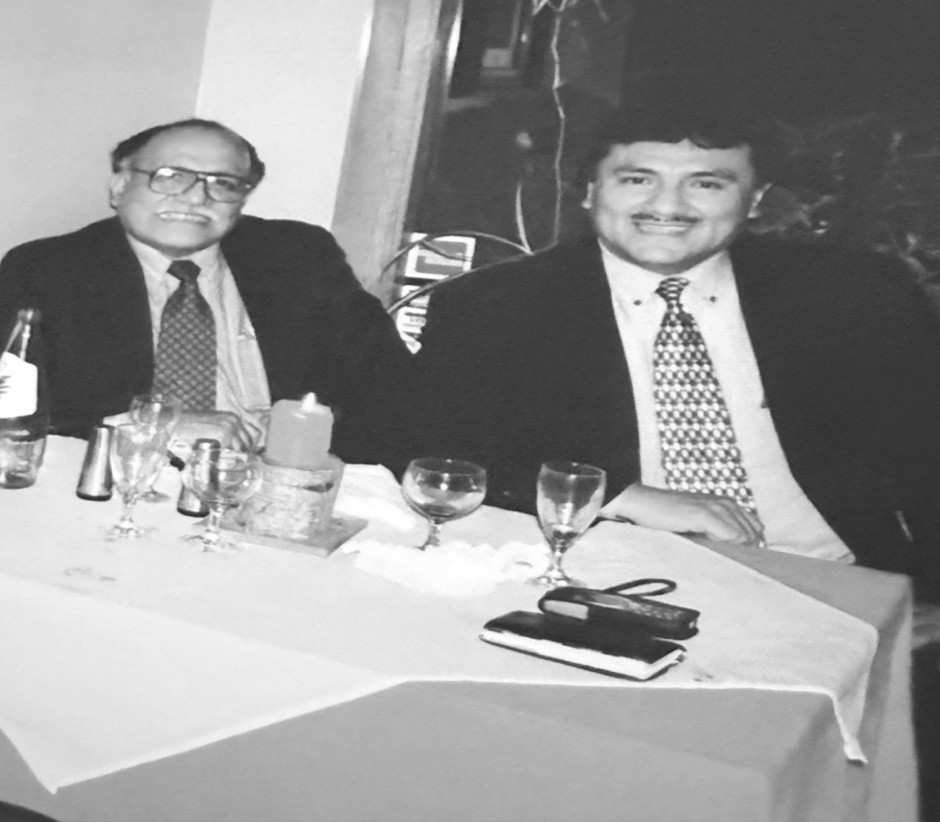
Picture of Samuel Escobar and Samuel Cueva
In the city of Valencia, Spain, in the early hours on Tuesday 29th of April, Samuel Escobar attended an unavoidable appointment with Jesus Christ at the age of 90. He was a respected missiologist from Latin America who built bridges with the evangelical community on every continent.

Samuel Escobar was born in Arequipa, Peru, in 1934. He moved to Lima to study literature at the National University of San Marcos, and after graduating, he dedicated himself to teaching. From 1954 to 1985, he worked with the International Fellowship of Evangelical Students in Latin America and internationally. In 1979, he was ordained a Baptist pastor and appointed pastor of Ebenezer Church in Miraflores, Lima, Peru, until 1984. He then began his cross-cultural work, living in various countries such as Argentina, Canada, the United States, and finally Spain.
Escobar has been an influential leader in Latin American theological reflection in dialogue with global Christianity. He served as President of the American Society of Missiology in 2002. He has taught missions at various theological institutions, and his key contribution to the development of a Latin American missiology is integral mission and social responsibility expressed through book publications, numerous articles in the journal Certeza, and other avenues. Some of his publications includes, The New Global Mission (2003), Time for Mission, and In Search of Christ in Latin America (2019). He was greatly influenced by mission theologians and thinkers such as, the Scottish Juan A. Mackay, the Spanish Miguel de Unamuno, the American Ronald Sider and the British theologian John Stott. José de Segovia recorded 20 radio programs with Escobar about his life and mission.
Escobar's legacy includes the founding of the Latin American Theological Fraternity (FTL) in 1970, serving as one of its presidents and later being named Honorary President, his significant contribution and participation in the integral mission discussions as part of the formation of the Lausanne Movement in 1974 in Switzerland, his recognition as one of the fathers of the Lausanne Movement, and finally, his contribution to the development of the International Evangelical Student Movement known as IFES. Regarding his theology within the Lausanne Movement, Escobar, along with René Padilla (1932-2021), proposed the great need to understand that evangelization is inseparable from social responsibility, and together they developed the missiological concept of integral mission to proclaim the gospel in words and deeds. He openly questioned the presence of managerial missiology in mission activity and entrepreneurship.
His great work as a thinker continually led him to develop a critical analysis of the mission of the Church in and from Latin America. He loved buying and reading books; it was his passion. One day he said to me, "Namesake, the practice of writing has to be every day." Every time I organized the Mission for the Third Millennium’s conferences, I asked him to give three topics; he replied, "two is fine, namesake," it was his great humility that impacted as mentored me. Samuel Escobar supported me in every way possible. Once, he sent me the book on his doctoral thesis on Paulo Freire (1921-1997) the Brazilian liberation theologian, and on another occasion, all the documentation of the historical process of the formation of the Latin American Theological Fraternity. He loved to help those dedicated to researching the history and new trends in the mission of the Church.
My tribute to my great friend Samuel Escobar, theologian, missiologist, professor of missions, and writer. He was my mentor and close friend for over 35 years, and helped me with my doctoral thesis. During our friendship, we shared insights into the history, present, and future of Christian mission in and from Latin America. His passion was to see a contextual missionary theology born in Latin America. When I published my first book, La Iglesia Local en Misión Transcultural, in 1988, Samuel wrote the prologue, and when my doctoral thesis was published in English, he prepared an endorsement to be included in the book. He had a great appreciation for me and wanted to see me succeed.
Our beloved Samuel is a role model for the entire Latin American Church, and he will be remembered for his humility, his smile, and his emphasis on integral mission with social responsibility, and the organization of CLADE – Congreso Latinoamericano de Evangelización.
I wish to add a warm greeting to his adult children, Lily and Alejandro; may the peace of Jesus comfort them, and may they know how grateful we are to God for the father they had, a man who knew how to live humbly and persevere in his dream of seeing Latin Americans deepen their critical reflection on God's mission. His works continue to follow him.
Samuel Cueva, PhD.
London 30/04/25
 Centre for Missionaries from the Majority World