Introduction
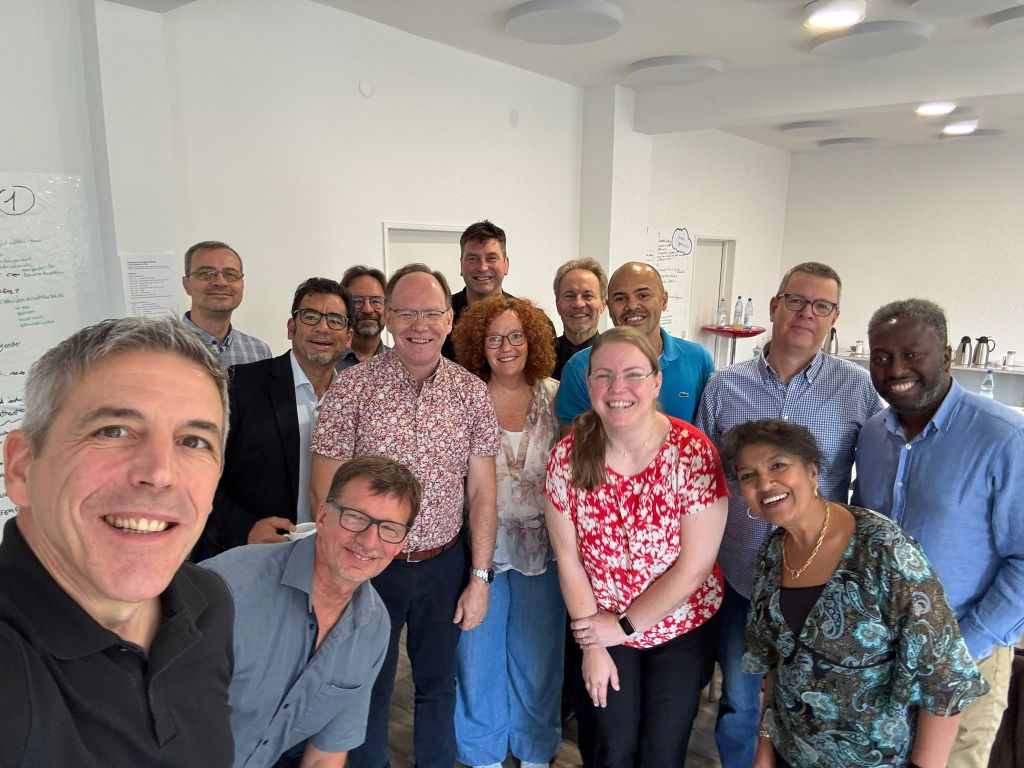
Group Picture of Participants
In the beautiful city of Frankfurt Germany gathered together fourteen key mission leaders from different mission networks and organisations all across Europe. The leaders represent European Evangelical Alliance (EEA), European Evangelical Missions Association (EEMA), Evangelical Mission Associations from Germany, Switzerland and the Netherlands, the One People Commission of Evangelical Alliance UK, Global Connections, All4Aid, Wycliffe, ReachGlobal and Lausanne Europe. One of the objectives of the mission consultation was to reimagine Europe in a Polycentric mission World through exploring our role (that is Europe) in the future of global mission in a changing missional landscape. In a world where mission is no longer centred in one place, but expressed through many voices, movements and regions, Europe finds itself at a strategic crossroads. What is the contribution of European mission networks and leaders in this new reality? What does it mean to lead, collaborate, and serve in mission – from and to Europe? Part of the aim of the mission consultation was to also reimagine a vibrant, relational, and missional European Evangelical Mission Association (EEMA).
Preparation for the Mission Consultation
In preparation for the mission consultation participants were asked to come prepared to reflect and engage the following key questions:
From your (European) perspective, what are the most urgent needs right now regarding mission and collaboration? Both in Europe and from Europe to the rest of the world.
Which challenging questions should missionary organizations and networks be willing to confront?
What specific opportunities do you see for your country/mission networks/organization to contribute within this European context?
Are there any concerns, reservations, or critical points you think should be raised in the discussion?
What kind of resources (e.g., podcasts, articles, research, books, blogs) were helpful in your preparation to our gathering?
These questions shaped the framing of the gathering as leaders were put into different groups wrestling with these questions. Each leader also shared about their context and what they see God doing. One commonality that emerged through each leader sharing was the diaspora developments all across Europe. Another area of commonality was around the engagement with young people and leaders. These two area became a focal point for several aspects of the consultation. Below is the summary of key points for discussed, these is grouped into four key areas
1. European Indigenous Mission and Diaspora Mission
Europe is deeply shaped by diverse diaspora communities, challenges, opportunities and needs — these ranges from migrant missionaries such as reverse missionaries to refugees to inter-European migration such as eastern European migration to western Europe. This broad framing around migration in Europe requires and necessitates a call for moving beyond a narrow “diaspora missiology” that only situate diaspora mission with the context of Majority World communities in Europe towards a truly intercultural missiology, where diaspora missiology can intersect with indigenous European missiology. Afterall, the word diaspora as used in the New Testament refers to the whole ministry of the church in terms of the scattering nature of believers and not some sections of the church. In essence, diaspora missiology must be addressing multiple migratory shifts and patterns in Europe and this requires indigenous Europeans working together with Majority World communities in Europe to form new expressions of church and mission. To do this, we must unpack realities honestly, break down silos, and recognize that Europe is not monolithic but richly diverse.
2. The Younger Generation and Intergenerational Conversations
The intercultural conversation must connect with the intergenerational dynamics of both church and society. The intergenerational conversation involves looking at those we will refer to as second and third generation migrants. Although many second and third generation migrants see themselves as Europeans because they can speak European languages, they were born in Europe and have adopted a European worldview. In addition is that a rising generation is seeking purpose and belonging. They are more open to collaboration, innovation, and holistic mission that embraces justice concerns such as climate justice and other social justice concerns. Their energy and vision will be crucial in shaping the future of mission in Europe. But one of the key challenges is that too many mission gatherings, consultations and conferences still marginalises younger generations and emerging leaders. This needs to change if we are going to centre younger voices within European mission movements.
3. God at Work in Europe
Amid secularization and post-secularisation, there are unmistakable signs that God is moving. There are stories of renewal, new communities forming, and unexpected growth in faith. The Quiet Revival in Britian is an example of how many young people particularly young men are seeking faith and spirituality. Sharing these stories nurtures hope, strengthens collaboration, and helps us discern how to join in God’s work.
4. The False Dichotomy between Mission and Church
In many parts of the Majority World mission flows out and through the agency of the church, but in Europe, mission organisations are separate from church and church networks therefore mission, particularly overseas mission appears to flow out of mission agencies and organisations. Whilst there are historic reasons for this, at present, this is no longer sustainable because many churches now organise their own overseas mission as well home mission therefore questioning the relevance of mission organisations. At the same time, there are tensions and confusion about the respective roles of churches and mission organizations. Clarifying responsibilities, building trust, and fostering partnership will be essential if we are to move forward together.
European Public Missiology: A Diaspora Perspective
As mention above, a common agenda that seems to dominate the discussions was around diaspora communities and mission. My reasoning is if in a European mission consultation with less diaspora in the room, why did diaspora mission and communities emerged as a key point and what is the ramifications of this for a European missiology? More crucial for me is, how do we develop a European Public Missiology that can address the various shifts and changes in European societies? A European Public Missiology goes beyond equipping European churches in mission and evangelism, it is thinking broadly of engaging the European public and the various shifts, trends and currents in society. With the significance of diaspora emphasised in our discussions, a European Public Missiology whilst not limited to the following agenda, will definitely seek to engage the following questions.
How can European Public Missiology engage the rise of Islam and also tackle the rise in islamophobia?
How can European Public Missiology contribute towards decolonising mission?
How can European Public Missiology address migration and engage the migrating witnesses that God is sending to Europe?
How can European Public Missiology challenge Christian nationalism but also help to develop Christian citizenship and public witness?
I will attempt to address three of these issues not as the last word but as a contribution. It is also important to mention that there are several European public theologians through University faculties, theological colleges, journals (Vista Journal, European Journal of Theology, Theological Reflections: Eastern European Journal of Theology), and research centres that are addressing various public issues in Europe.
Rise of Islam and Fear of Islam
One of the central concerns of many evangelicals in Europe is the rise and growth of Islam in Europe. Islam as a migratory and missionary religion is a world religion that is growing therefore begs the question how do we engage Islam in Europe? Do we engage through dialogue or seek to convert through evangelism? An ecumenical approach in Europe tend to engage Islam through inter-faith conversations and dialogue whilst evangelical approach tends to be mainly through evangelism. A bigger concern however, from the church and society is around the narrative of some Islamist extremists who might have an agenda of Islam taking control of Europe. The sense of fear around this propaganda easily leads to an unhealthy fear of Islam and all Muslims. The challenge therefore is how do we engage Islam and Muslims in a healthy way without demonising all Muslims? To begin to address this fear, evangelicals in Europe whilst engaging in evangelism must also seek to understand Islam and engage in meaningful dialogue that can lead to peace-building in creating meaningful existence.
Immigration and Nationalism
Immigration is a contested issue all over Europe at the moment because of the increase in the number of legal and illegal migrants trying to cross over into Europe. As a result of migration, European societies have become multicultural therefore leading to different approaches of trying to manage multiculturalism and control migration. Some countries are doing this through assimilation where migrants are expected to fit in into the current culture and system, whilst others are experimenting with integration as an approach that welcomes migrants around a community cohesion. Yet there are other countries where migrants are living in siloed communities, sometimes not intentionally and on other occasion intentionally. In the attempt of some European countries managing migration, the rhetoric and politics of nationalism have emerged fuelled by extreme-right politics. We see the rise of extreme-right politics through political parties such as Marine Le Pen’s National Rally (RN) in France, Farage Reform in the UK, Fratelli d’Italia (Brothers of Italy) in Italy, Freedom Party in Austria, Alternative for Germany (AFG)in Germany and many more.
The Uk is currently going through a public shift as average citizens feeling that the government have not done enough to make them safe by securing our borders have therefore take matters into their own hands through protests at hotels housing refugees. The current anti-immigration protests is using English flags to display a patriotism rooted in a search for belonging albeit rooted in prejudice as hijacked by far-right protesters and political rhetoric. I live in Essex which is not too far away from where the protests have been happening for months in Epping. Nearer to the part of Essex I live is changing with visible signs and identity marker with English flags. This includes zebra crossings, billboards, public drawings, displays and a shocking N-word sign at a children family park. Racism is on the increase in the Uk through all these anti-immigrant protests fuelled in part by extreme right politics, rhetoric and language. Anti-immigrant protests have taken place in Bristol, Liverpool and London, as well as in Mold in Wales, Perth in Scotland and County Antrim in Northern Ireland. Other protests took place in Exeter, Tamworth, Cannock, Nuneaton, Wakefield, Newcastle and Horley in Surrey.
The narrative around migration and nationalism creates a double challenge of tackling toxic nationalism in Europe and developing migration theologies that equips the church to engage migration with a different narrative to society. How can European Public Missiology develop a patriotic theology that tackles toxic nationalism and at the same time develop migration theologies that challenges the demonisation of migrants? This process will again involve intersecting European indigenous mission and diaspora mission.
Mission and Power
The colonial history of Europe can not be ignored in the construction of a European Public Missiology. This is because the trans-Atlantic slavery, imperialism and colonisation is a shared history between Europeans, Africans, Caribbeans, Asians and Latin Americans and therefore an attempt to develop a theological framework in Europe must reflect on these themes. In essence, a European missiology without a decolonising missiology will not be a complete missiology in Europe in my opinion. The colonial history must be interrogated to disentangled mission from power , but perhaps a crucial task is how can Europeans and Majority World Christians in Europe decolonise mission together? This will require an intercultural approach to decolonising mission.[1]
Conclusion
In summary, the Frankfurt mission consultation was a catalyst towards reimagining European mission and its role in a globalised world with the implications of World Christianity. European Evangelical Missionary Association (EEMA) have been quiet for many years. Now the idea has arisen to create a new European mission network connected to the identity of the European Evangelical Alliance (EEA). Within the World Evangelical Alliance (WEA), the mission network is also being reorganized. This therefore presents a good opportunity to create a mission network within the EEA. The structural change will involve and require a decision-making process in each country. At this stage, we can monitor the change processes and actively influence it, as we did at the Frankfurt consultation on September 1-2, 2025. But one thing that seems clear to me is that we need to be working towards a European Public Missiology that is relevant for the current context of change in Europe and beyond.
[1] See for example Israel Olofinjana, Why Did Jesus speak Aramaic? A Biblical Theology for a Decolonised Mission, Centre for Missionaries from the Majority World (CMMW) Essay. Available at https://cmmw.org.uk/2025/04/11/why-did-jesus-speak-aramaic-a-biblical-theology-for-a-decolonised-mission/
 Centre for Missionaries from the Majority World
2 thoughts on “Towards a European Public Missiology”