Introduction
This year I have had the opportunity of visiting my beloved continent more than once. The first was a Tearfund trip to Lilongwe Malawi to view some of the projects around how churches are playing crucial role in community transformation in the villages. A second trip was to Abidjan Cote d’Iviore for a mission consultation organised by Movement for African National Initiatives (MANI). These two trips separated by a week have left me with a profound sense of how Africans are developing their own initiatives and contributing to human development and global mission. These two experiences in two distinctive parts of the continent gives an example of how Africans are developing their own missiology. This missiology is shaped as will be reflected in this article through community transformation and a sense of mission to reach all of Africa with the gospel. In essence, African missiology captures the proclamation and expression of the gospel.
African Development: The African Story of Hope

On the first day we visited one of Tearfund’s project in the Dowa district in Lilongwe. The Mponela project is supported by Tearfund and other partners such as Ministry of Hope.
The project is very dynamic with a community of mostly women being empowered to develop their own agency to alleviate poverty and develop sustainable economic and environmentally friendly approaches through greenhouse farming. This is done through a self-help cluster group and a well-structured co-operative farming community. Seeing and hearing the stories of how women, young and old are developing their own economic empowerment through indigenous Pentecostal Christianity in bringing community transformation to their households and wider community is very inspirational. One of the women told her story of how she started a bakery in the local community and was able to send one of her daughters to school. Another told us how at the age of 25 she has started her own hair salon business.
Men are also involved in this project through some of the local Pentecostal churches and other denominational pastors who participate through sharing God’s word with the community. But some of the pastors have also developed their own self-sustaining businesses and farming to be able to feed their families and contribute to wider society. As one Baptist pastor told us, his understanding of Genesis 2, a foundational life-giving text for him, was that God has provided all that humanity needs therefore there are resources within and around him that he can use to address poverty and develop sustainable income so that he doesn’t depend on anyone. This pastor’s story reminds me of the Desert Fathers in North Africa who engaged in farming in order to sustain their monastic lifestyles and also in the process were able to help the poor around them. This is evidenced in the monastic pursuits of Antony (AD 251-356), Paul of Thebes (AD 230-341) and Pachomius (AD 286-346). They were able to developed an African indigenous spirituality that was communal and addresses poverty in the community. What we saw and heard, which could theologically be described as an indigenous transformational Pentecostal Christianity in the context of Malawi in my opinion is one of the ways forward in Africans continuing to develop a hermeneutic of empowerment.
On the second day, we visited a different project in a different village. The project in Mazengera involves an ecumenical church leadership that consists of Catholics, Baptists, classic Pentecostals, independent Pentecostals and indigenous churches. The project also involved sponsoring partners such as Tearfund, Ministry of hope and local traditional leaders collaborating together. The farming community are trained in afforestation practices such as planting several trees. The training provided helps to develop a community in producing and marketing farm produce. There was also a bee keeping business run by one of the local farmers which produces honey. There are about 75 self-help groups which has grown to 250 groups over few years. With Tearfund training the villagers have also developed village banking for the community to keep their money reducing the time of travel into the city. The community is also involved in manure production which sets apart their farm products. One of the purposes of the self-help groups is to empower the community to provide practically for their families, reading scriptures together, praying together and building the church and community.
On day three we visited another project in the Salima area which is run by an Assemblies of God church in collaboration with other churches, the Muslim community and traditional leaders. The project is called AG Care. AG Care focuses on several areas such as food security, environmental resource management, climate and economic empowerment, health and humanitarian response. It was good to see an African Pentecostal church engagement on climate and environmental concerns. Part of the work they do is environmental conservation through addressing deforestation. One of the uniqueness of the AG Care project was the inter-faith element in the community. Christians are working in community with Muslims and traditional leaders.
In concluding this section, the Tearfund visit to Malawi was very strategic for the following reasons:
Firstly, is that the delegation from the UK where Africans in British diaspora visiting an African country learning about how ordinary African Christians are developing their own agency in alleviating poverty. The delegation from the UK consisted of different people from different African countries. There were Ghanaians, Nigerians, Rwandans and Ugandans representing different aspect of African Pentecostal and Charismatic movement.
Secondly, the delegation from the UK where not really there to help their brothers and sisters, but rather witnessed how Malawians are developing self-help to address practical needs and poverty issues. In this approach of observing community transformation, we were more learning than giving.
Lastly, a common practice for each of the days was meeting the community through seating together under the shaded tree. This in itself reflects an African traditional way of learning and building a community.
Movement for African National Initiatives (MANI) 2026 Consultation
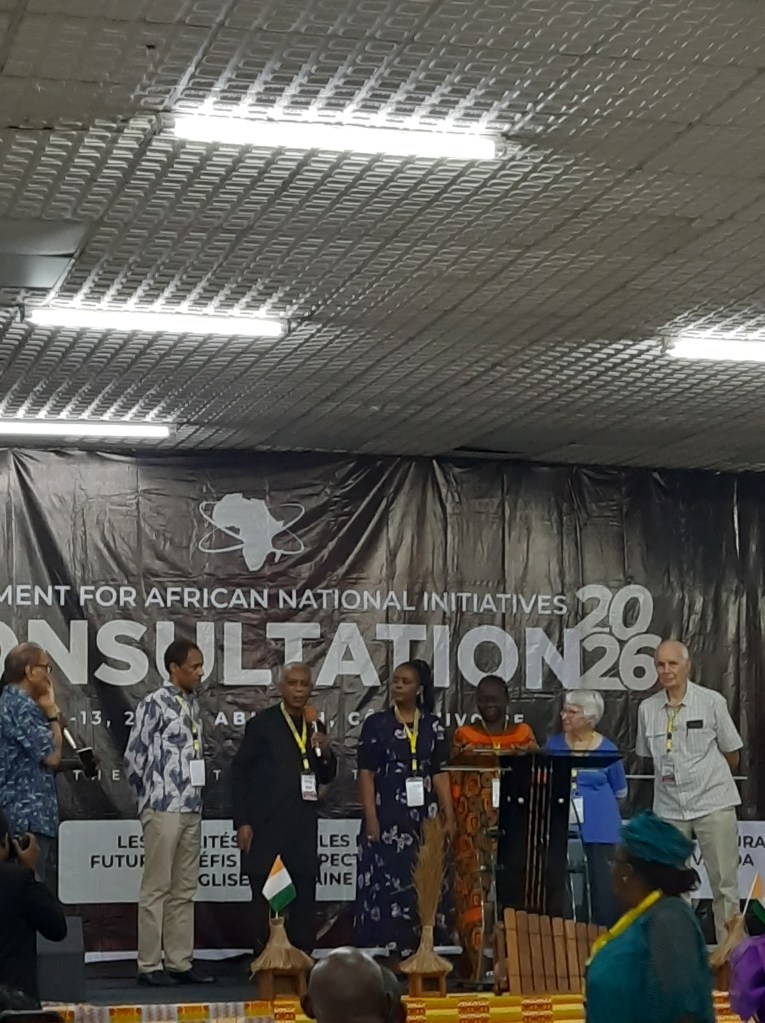
The Movement for African National Initiatives 2026 consultation with the theme of, Present and Future Realities, Challenges and Prospects of the African Church had around 450 delegates from all across Africa and beyond in attendance. Geographically, in attendance were different African Christians from west Africa, east Africa, central Africa, north Africa and Southern Africa. Linguistically, in attendance were Anglophone Africans, Francophone Africans, Lusophone Africans and Arabic Africans. The African nations represented geographically and linguistically demonstrates not only the diversity of African Christianity and indeed the diversity of its mission movement, but more importantly reveals the global nature of African Christianity. The geographic and linguistic composition of the consultation also shaped the content of the programme in terms of speakers, worship, Bible study sessions and plenary sessions.
Movement for African National Initiatives (MANI afterwards) emerges from the 40-year history of African national movements and was given full expression during the AD 2000 and Beyond Movement era. The history of national initiatives in Africa dates to the 1960’s when many African nations gained independence.[1] MANI was birthed in March 2001 in Jerusalem with 320 delegates from 36 nations for the African Millennial Consultation. Since its inception, it has gathered in Nairobi, Kenya in 2006, Abuja, Nigeria in 2011 and Addis Ababa in Ethiopia in 2016. There are few things that makes the consultation this year significant. Firstly, is that it marks the 25 years since MANI started in 2001. Secondly, is the development of a Francophone missiology because, it is the first time that MANI consultations will take place in a Francophone country in Africa signifying the understanding of the unique and strategic position of Francophone Africa in relation to the Francophone world. In this respect, a major mobilisation strategy of MANI through several of its consultations is reaching north Africa with the gospel, which once had a large Christian presence. Francophone Christians from west and central Africa through the language connection with places such as Morocco, Tunisia and Algeria are able to engage effectively in this mission strategy and mobilisation. Francophone countries accounts for half of the continent with 26 Francophone countries therefore making the francophone mission mobilisation an important one. Lastly is that the gathering marks a change in leadership from Rev Dr Reuben Ezemadu, a Nigerian who has led MANI for the past 20 years to my friend Peter Oyugi who is Kenyan. In this change of leadership, it is also important to acknowledge the founding leaders and pioneers of MANI in Jerusalem in 2001, this is in the ministry of Ross and Avrille Campbell who were celebrated for their pioneering work on the continent over the years.
Peter and his wife Cecilia were commissioned by the leadership of MANI through prayers and laying on of hands. Peter Oyugi taking on the leadership of MANI is quite strategic and important. Peter Oyugi is one of the few African mission leaders who understands mission on the continent and beyond. He is also one of the few leaders who has managed to developed important relationships with other global and regional mission movements such as the World Evangelical Alliance (WEA) Mission Commission, Latin American Congreso Misionero IberoAmericano (COMIBAM), European Evangelical Mission Association (EEMA), Christ Over Asia, Africa and Latin America (COALA) and Majority World Christian Leaders Conversation (MWCLC). These networking skills and missional ambassadorial role has been done with deep humility and character that is much needed in a period when many senior church figures globally have egos and scandals attached to their names. Peter as a Kenyan leading MANI is also very important because whilst Nigerians have played a crucial role in MANI’s development, it is very important that MANI does not feel like a Nigerian project but more as a pan African indigenous mission initiative.
MANI as a pan-African indigenous mission movement has three convictions:
The Church in Africa has a crucial role to play in the fulfilment of the great commission in the 21st century.
The Church in Africa has the ministry gifts, manpower, and material resources to complete this task in Africa and to make a significant contribution towards global evangelisation.
Through the focused deployment of the resources of the African Church, we can partner with the global church to achieve the target of a church for every people and the gospel for every person in the countries of Africa and the world. These convictions are achieved through MANI’S playing a critical role in encouraging and establishing national indigenous mission initiatives in African counties where a national mission initiative does not exist. In the context, where a national mission initiative exist, MANI comes alongside national churches to strengthen and increase the capacity. MANI therefore exists to catalyse national mission initiatives to fulfil the call to share the gospel everywhere.
One of my observations at the consultation was that there are many young people involved in the African missionary movement. I spoke with several young missionaries in their 20s and 30s who were committed to the task of mission on the continent. This young mission force is very strategic for the continent because the African continent has the youngest population with around 47% of its people being the under the age of 18.
Another key observation of the consultation is hearing several stories of brave and bold missionaries responding to God’s call to go to the most difficult and uncomfortable contexts on the continent. The stories of the African missionaries I heard was very similar to the stories of the apostles in Acts of Apostles who were willing to suffer persecution for the sake of the gospel. One could argue that the story of African mission is one of suffering and sacrifice to reach people with the gospel. The story of the African Church is therefore a suffering church because of the nature of ongoing religious persecution on the continent. The participants were reminded by one of the African missionaries serving in north Africa that Christians should not fear the first death but hope in the Christian reality of the resurrection. It was quite powerful and encouraging to hear different stories of how African missionaries are suffering persecution on the continent.
A third key observation is the encouragement for Africans to document and tell their own story of African mission engagement. It was powerfully articulated that Africans for various reasons have not tell their own story in mission. It was therefore very significant to highlight how Africans have begun to document and tell contemporary stories of African mission. To this end the contributions of Victor M Tukura, a Nigerian lawyer and mission mobiliser was celebrated as an African who is documenting the role of Africans in mission initiatives.[2] This include biographies of contemporary African missionaries and perhaps one of the most important works of Tukura is capturing the story of MANI as a movement.[3]
In sending out the African Church from the consultation were six areas of priorities which could be described as declarations. They six areas of priorities are:
1. Renewed MANI Vision & Strategic Leadership
2. Mission Mobilization & Cross-Cultural Training
3. Church Unity, Collaboration & Partnerships
4. Addressing Persecution & Political Instability
5. Transformational Discipleship & Youth Engagement
6. Contextual Challenges & Opportunities
In conclusion, MANI as a catalysing mission movement in Africa and beyond have journeyed a long way from starting with the pioneer ministry of Ross and Avrille Campbell who were from New Zealand to handing over the leadership to an indigenous African in the person of Rev Dr Reuben Ezemadu. Rev Ezemadu also handing over the leadership of MANI to Peter Oyugi after 20 years of leadership at the 25 years of marking the ministry of MANI is also very important as the leadership shifts from a Nigerian to a Kenyan. The work of MANI continues to give hope to the continent as it remains strong as a catalysing mission movement among Africans and therefore represents one of the ways in which Africans are taking initiatives in global mission.
[1] Movement for African National Initiative, Vision and Strategic Framework for Africa’s Mission Mobilisation (available in English, French and Portuguese), 2026.
[2] Attendees at the conference were given five books written by Victor Tukura as part of encouraging the documentation of African mission story.
[3] Victor. M Tukura, An African Missions Ambassador (Abuja, Nigeria, MSL Publishing, 2023).
The MANI 2026 Declaration Abidjan Consultation is attached as a PDF to download
 Centre for Missionaries from the Majority World